Play solo free in your browser, without installing anything. Multiplayer and the ladder are available on Steam and Google Play. Browser progress stays in this browser and is not submitted to the online rankings.
How to play
Bring matching fruit together to make bigger fruit. Start with the open spaces, then look one move ahead: where will the next fruit fit?
What to watch in your first round
The fruit hanging above the board is the one you are about to drop. The small box on the right shows the next one. Move your current fruit, then release it: it will hit the pile and roll. It does not travel straight through the stack to the position you aimed at.
The drop queue contains blueberries, strawberries, kiwis and grapes. Apples and larger fruit are made on the board. Instead of waiting for an apple to appear in the queue, work on bringing two grapes together.
Find the first surface, not just the matching fruit
A matching fruit under a large one is not an open target. Follow the drop line to the first surface it will hit. A rounded side can send it sideways; the inside of a banana can hold it in place.
Leave a route for the next piece
Repeatedly filling the lowest side can close its entrance. Check the next-fruit box and ask whether that piece will still fit after your current move. The two sides do not need to be perfectly level.
Allow room for the result
Two striped melons become a watermelon. There are fewer objects, but the new watermelon still takes up space. Wait to see which way it settles before committing the next drop into a gap that may already be gone.
A shake does not tidy the board for you
Have a particular pair or obstruction in mind before spending one. A shake also moves the small fruit supporting the larger ones, so it can raise the pile as well as open a route. Let one shake finish before deciding to use another.
Choose a fruit and a number to see what they make and how many points you earn.
Result
Kiwi
Score
10
Fruit used
2
Bananas need a group of three. This shows one merge; any follow-up merges depend on the fruit around it.
From blueberry to Golden Banana
Two matching fruit create the next fruit in the chain below. Bananas are the exception: three touching bananas create one Golden Banana. Two Golden Bananas disappear, making room and awarding 2,000 points.
Each round starts with five shakes. Merging fruit gradually fills the token at the bottom of the screen. Fill it completely to earn another shake. Bigger merges fill it faster.
Making two watermelons earns one shake, for example. The number is how many shakes you can use now; the filling icon shows progress toward the next one. Try a shake when matching fruit are almost touching or a small gap needs opening.
Token progress earned by the fruit created in a merge
Created fruit
Token progress
Strawberry
3%
Kiwi
6%
Grape
10%
Apple
15%
Peach
22%
Pear
32%
Korean melon
40%
Watermelon
50%
Banana
100%
Golden Banana
300%
Controls
Action
Touch or mouse
Keyboard
Gamepad
Move aim
Drag the aim area or hold left/right
A / D or Left / Right
D-pad left/right or left stick
Drop
Release the aim or tap the drop control
W or Enter
A
Fast drop
Hold the orange down button
Hold S or Down
Hold D-pad down or right trigger
Shake
Tap the banana button
Space or M
X, Y, or left shoulder
Pause
Tap the pause button
P or Escape
Start, Back, or B
Restart
Use Restart from a menu
R during play
Use the pause or game-over menu
Play tips
Start with the final moments of a recorded round that did not work out. Then try three positions to practise reading paths and making room for a merge.
When the last shake was not enough
Watch the last shake
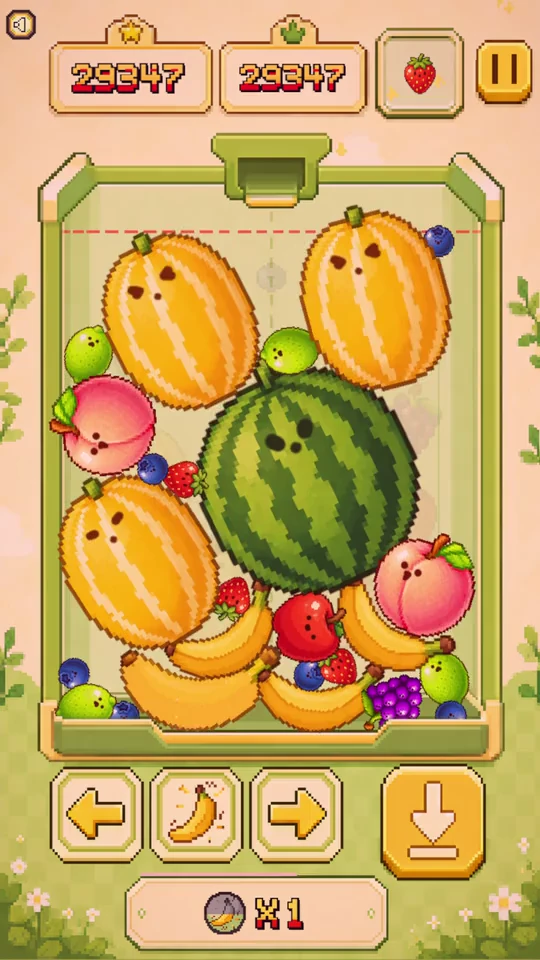
The two striped melons near the top could make a watermelon, but a kiwi sits between them. A large watermelon fills the middle, and only one shake remains.
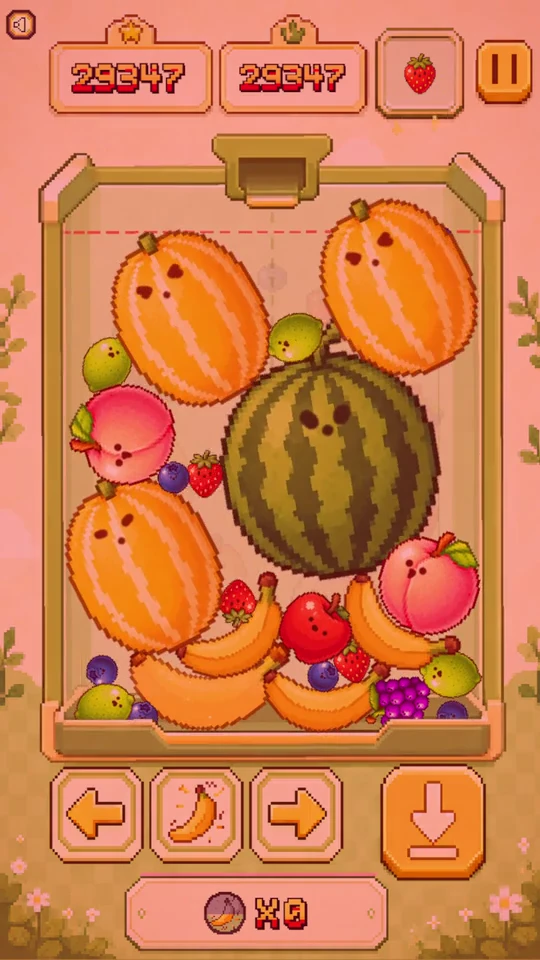
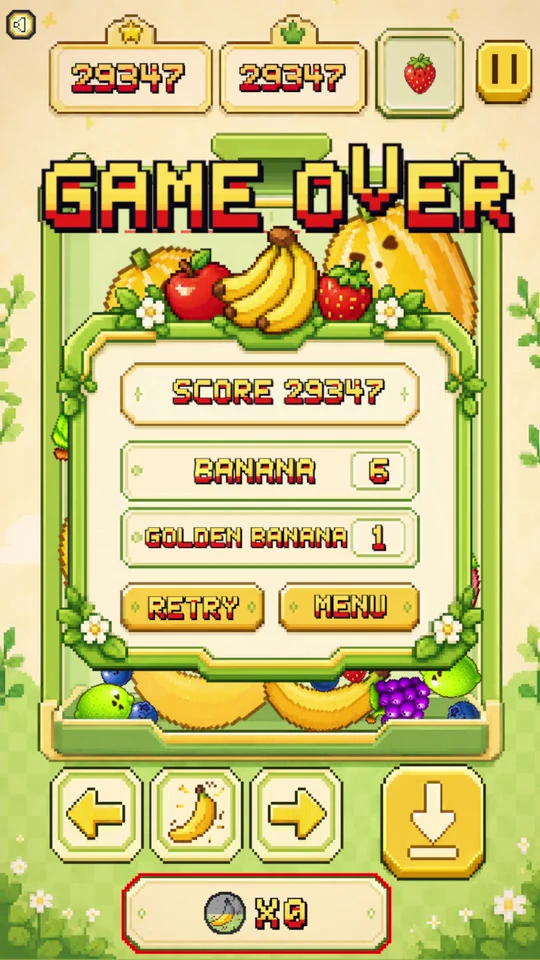
The shake moves the pile, but the melons stay apart. Saving a shake did not help once there was too little room for the fruit to move.
One thing to take into the next round
Save room as well as shakes. Before making a large fruit, check whether the spaces beside it will still let the next fruit through. That gives you more options before the pile reaches the top.
1. One shake left The kiwi and the central watermelon block the way.2. After the shake The pile moves, but the two melons are still apart.3. Round over The round ends at 29,347 points without another merge.
Your turn: read these three positions
Choose an answer and open the explanation. The video shows the same position in motion; pause it to inspect the supporting fruit. A low lane is useful only if the next fruit can actually reach it.
Mainu Studio gameplay recording · 11 September 2026
Watch this position in motion
1. A match under a curved shelf
Compare the reasoning
The route around the banana's tips
The banana blocks the approach from above. Inspect the openings around its tips: a newly merged apple needs a clear route before it can reach the apple below. Apples are made by merging grapes, not drawn as the next drop.
Only the apple's horizontal position
Matching the horizontal position does not make a falling apple pass through the banana. Its first contact may redirect it away from the target.
The total empty space above the pile
There is plenty of empty space, but the last part of the route is obstructed. What matters is whether the fruit can actually reach its partner.
Watch this position in motion
2. An open box can still have a dangerous side
Compare the reasoning
Any drop is safe because the bottom is mostly empty
Empty space at the floor does not mean a new fruit can reach it. A landing on the right can add height even while the left remains open.
The tall right side and the lower left route need separate attention
The right-hand apple is much higher than the fruit on the left. Check the low route for a reachable match instead of treating the whole surface as equally safe. The frame catches motion, so watch it settle first.
A shake will definitely level the pile
A shake moves the supports as well as the top pieces. It may open a route, but can also lift or tip the stack; this frame cannot establish a guaranteed rescue.
Watch this position in motion
3. A merge is not always a clear
Compare the reasoning
Both melons disappear and leave an empty gap
An ordinary merge replaces two fruit with one larger fruit. It does not remove the result from the board.
A banana appears immediately
Two watermelons make a banana. The two striped Korean melons are one step earlier in the chain.
Another watermelon needs somewhere to settle
Two Korean melons produce a watermelon for 130 points. The kiwi between them can delay contact, and the existing central watermelon constrains where the new result can move. Check space as well as the possible score.
Where would you drop the next fruit?
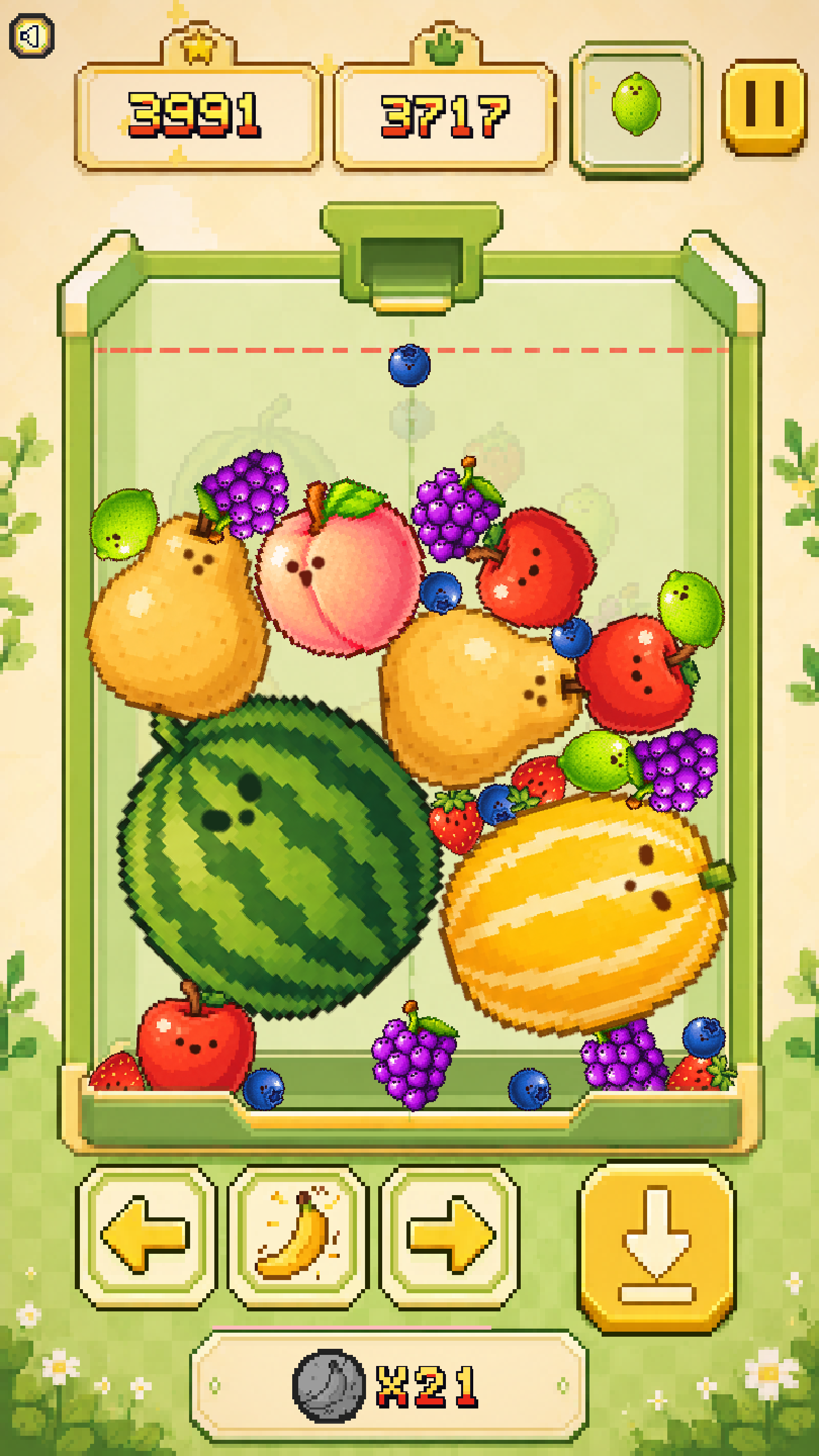
A blueberry is ready to drop, with a kiwi coming next. The watermelon at the lower left and the striped melon at the lower right take up most of the space. Look for a path through the smaller fruit above them.
Find an exposed match. A blueberry sits just right of the large peach, above the central pear. Aiming toward that pocket is a candidate move, but the grape bunch above it may intercept the falling fruit. Check the visible route, not just whether a matching fruit exists.
Ignore the tempting buried matches. Several blueberries lie at floor level. The two largest fruit block their direct landing routes. Dropping above a buried match will not make the new fruit pass through the stack.
Plan for the preview. There are kiwis near both outer edges. Keep at least one of those routes usable for the next piece instead of building a new tower above both sides.
Use the 21 tokens deliberately. There are two pears and several apple-sized obstacles, but the large fruit support most of the board. A shake could create a useful contact or raise a new obstruction. Watch one shake settle before spending another.
For practice, name the match you expect before each drop, then compare the landing with that prediction. If it misses, look for the first surface that deflected it. This makes the next decision more useful than repeatedly aiming at the same buried fruit.
3,717 · Banana Game
Making the game
A small fruit can settle inside a banana, while a shake can rearrange the whole pile. Here are a few of the problems we worked through to make those moments feel right.
Fruit that seemed to float above the floor
This floor-fix story shows battles on Steam and Google Play. The browser version is single-player only; it does not support multiplayer.
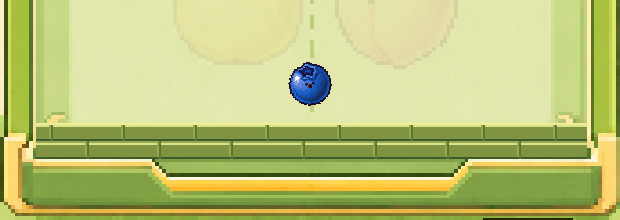
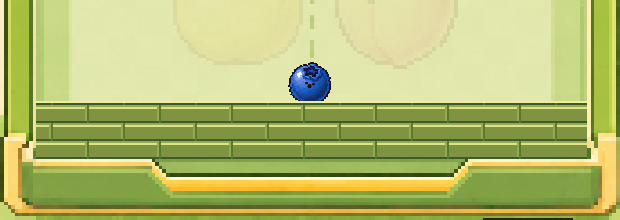
When the battle floor rose, gaps sometimes appeared beneath the fruit, or bricks covered their edges. The floor was misaligned on tall screens such as 1440x2960.
Before · Android reproduction A gap remains beneath the resting blueberry.After · Windows check The brick surface meets the fruit, with the front rim still visible.
Start with just one fruit
A crowded board hid the problem, so we dropped a single blueberry. That made it clear: the floor we could see was not at the height where the fruit actually stopped.
Move the drawing, not the pile
Pulling the fruit downward would disturb the board. Instead, we aligned the floor artwork with the surface supporting the fruit. We also kept bricks inside the side borders and drew them behind the fruit.
Check it while the board changes
We checked the floor as a row rose, the screen changed size, and the board shook. Keeping the original front rim also stopped the bottom from looking open.
Why the inside of the banana stays open
Treating a banana like a round ball blocked its empty center. We shaped its support around the curve instead. Small fruit can settle inside, while larger fruit roll over the outside. The shape changes what happens next, even when you aim at the same spot.
One reward for each merge
When several fruit touch at once, the same fruit could be counted in two merges. Once a pair is chosen, we stop it from being used again. Its score and shake reward are then awarded just once.
The same board on different screens
Phones are tall and PC windows often leave space at the sides, but we wanted the board itself to stay the same. We scale it as a whole and leave spare space outside it. Buttons and the next-fruit preview follow the same layout.
Meet the maker
Hi, I'm Minwoo Park, the developer behind Banana Game at Mainu Studio. This site lets you play my game for free and look through real boards when you are stuck. I also share the changes made along the way. Please email me if something feels wrong or you spot a screen problem.
 Banana Game